


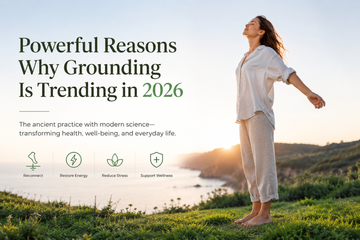
GroundingWell explores why grounding is having its biggest moment yet in 2026. Rising sleep problems, burnout, and social media awareness are driving millions to try earthing for the first time. A 2025 double-blind study found grounding mat users slept longer, while biohackers and athletes report measurable gains in heart rate variability and recovery. Over 20 peer-reviewed studies now back the practice.
Something shifted in 2025 and the momentum has only grown stronger heading into 2026. Grounding, the ancient practice of making direct physical contact with the earth, has moved from a niche wellness conversation into mainstream culture at remarkable speed. Millions of people who had never heard of earthing are now stepping outside barefoot, sleeping on conductive sheets, and feeling real differences in their sleep, their stress levels, and their energy. The timing is not random. At GroundingWell, we have watched this moment build for years, and we believe it is here to stay. Here are the powerful reasons why grounding is having its biggest moment yet in 2026.Table of Contents
- Key Takeaways
- Why 2026 Is Different
- Reason 1: The Sleep Crisis Is Driving People Toward Natural Solutions
- Reason 2: Burnout Has Reached a Breaking Point
- Reason 3: Social Media Made the Science Accessible to Everyone
- Reason 4: Biohackers Validated It Through Measurable Results
- Reason 5: The Research Base Has Crossed a Credibility Threshold
- Reason 6: People Are Exhausted by Complex Wellness Routines
- Reason 7: The Disconnect From Nature Has Never Been Greater
- Reason 8: Athletes and High Performers Have Made It Mainstream
- A Trend Built on Something Real
- Conclusion:
- FAQs
Key Takeaways
- The grounding product market is growing at over 35 percent annually through 2025 and 2026, reflecting genuine consumer demand.
- A 2025 double blind Korean study found that participants using grounding mats slept measurably longer than those using placebo mats.
- Burnout culture, the sleep crisis, and rising anxiety have created a massive unmet need that grounding addresses directly.
- Biohackers and wellness communities have mainstreamed grounding by demonstrating measurable effects through objective tracking.
- The research base has crossed 20 peer reviewed publications, giving grounding more scientific credibility than almost any comparable wellness practice.
Why 2026 Is Different
Grounding is not new. The first peer reviewed studies on its physiological effects were published in 2004. Clint Ober, often credited as the modern pioneer of earthing, was sharing his findings years before that. Athletes, functional medicine practitioners, and holistic health communities have known about grounding for decades.
But something fundamentally changed in the years leading into 2026. The combination of a sleep crisis, an anxiety epidemic, a social media boom in wellness content, and a growing consumer demand for natural solutions created the exact conditions in which grounding could break through. The practice did not change. The world caught up to it.
The grounding sheet market alone is projected to grow from approximately USD 1.1 billion in 2025 to nearly USD 9.2 billion by 2032, a compound annual growth rate of over 35 percent, according to market analysis reported by Neuroscience News and multiple industry sources. That level of sustained growth does not come from a passing fad. It comes from people trying grounding, experiencing something real, and telling others.
Reason 1: The Sleep Crisis Is Driving People Toward Natural Solutions
Sleep deprivation has become a defining public health problem of modern life. More Americans report poor sleep quality today than at any measured point in recent history. The market for sleep supplements, sleep trackers, weighted blankets, blackout curtains, and sleep apps has exploded. People are spending more money than ever trying to solve a problem that is getting worse, not better.
Into this environment came a 2025 double blind, placebo controlled study from Korea that found grounding mat users slept measurably longer on average after 31 days compared to participants using identical but ungrounded mats. As covered by The Conversation and Neuroscience News, this was one of the most rigorously designed grounding studies published to date, and it gave millions of sleep deprived people a credible new option to consider. When you can point to a double blind trial with objective sleep tracker data, the conversation moves well beyond wellness trend territory.
- Average US sleep duration has declined steadily since 2013 according to CDC data.
- Over 70 million Americans experience chronic sleep problems, per National Sleep Foundation estimates.
- The 2025 Korean study used sleep trackers and a rigorous double blind protocol, making it among the most credible grounding research to date.
- Grounding addresses sleep through cortisol normalization and autonomic nervous system calming, not sedation.
Reason 2: Burnout Has Reached a Breaking Point
Burnout is not a buzzword anymore. It is a clinically recognized occupational phenomenon characterized by exhaustion, cynicism, and reduced effectiveness, and it is affecting people across virtually every profession and age group. The pandemic years accelerated a trend that was already building, and the recovery has been incomplete.
People experiencing burnout are not simply tired. Their nervous systems are dysregulated. Their cortisol rhythms are disrupted. Their capacity to recover between demands is impaired. They are, in many senses, chronically stuck in a state of sympathetic nervous system overdrive, and conventional solutions like rest and vacation often do not fully reset the system.
Grounding addresses burnout physiology directly. As documented in the Chevalier et al. review in the Journal of Environmental and Public Health, grounding shifts the autonomic nervous system toward parasympathetic dominance, normalizes cortisol rhythms, and reduces the inflammatory markers that accumulate under chronic stress. These are not cosmetic wellness benefits. They are the specific biological corrections that a burned out nervous system needs.
Reason 3: Social Media Made the Science Accessible to Everyone
For years, grounding research lived inside academic journals and functional medicine circles. The people who knew about it were, for the most part, already in the wellness ecosystem. That changed when content creators started sharing grounding experiments on TikTok and Instagram.
Videos showing people testing their body voltage with a multimeter before and after grounding went viral. Before grounding: readings in the hundreds or thousands of millivolts. After standing barefoot on grass or plugging in a grounding mat: near zero. The visual is dramatic, easy to understand, and impossible to dismiss as anecdotal.
As reported by the Jerusalem Post and multiple wellness publications, the grounding trend went viral on TikTok in 2022 and has been building momentum ever since. By 2025 and into 2026, it had crossed from niche to mainstream, with content reaching audiences who would never have encountered grounding through traditional wellness channels. Social media did not create the science. It simply made it visible.
Reason 4: Biohackers Validated It Through Measurable Results
The biohacking community, people who optimize their biology through intentional, trackable interventions, were early adopters of grounding for a simple reason: it produces measurable results in the metrics they track. Heart rate variability improves. Resting heart rate decreases. Sleep stage data shows deeper sleep. Morning readiness scores go up.
When biohackers who are already wearing continuous heart rate monitors, HRV trackers, and sleep rings begin consistently reporting that grounding changes their numbers, those reports carry more weight than testimonials from people without baseline data. The biohacking community essentially ran thousands of informal personal experiments and reported back with objective measurements.
The physiological basis for these results is well established. Research published in Integrative Medicine: A Clinician’s Journal found that even 40 minutes of grounding produced measurable improvements in heart rate variability that continued increasing throughout the session. For biohackers who live and breathe by these numbers, findings like that create genuine enthusiasm and genuine sharing.
Reason 5: The Research Base Has Crossed a Credibility Threshold
Wellness trends live and die by their scientific backing. Practices supported by one or two studies remain fringe. Practices backed by a growing body of independent research from multiple institutions over more than two decades earn a different kind of trust.
Grounding crossed that threshold. As documented by Premium Grounding’s review of the scientific literature, over 20 peer reviewed publications on grounding and earthing have been published since 2004. These cover cortisol regulation, sleep improvement, inflammation reduction, blood viscosity, wound healing, pain reduction, and cardiovascular function. The researchers behind this work include cardiologists, physiologists, and integrative medicine specialists at institutions including Penn State University Medical Center. That is not the profile of a fringe wellness claim.
- Over 20 peer reviewed publications have appeared since 2004.
- Independent research groups across the US, Europe, and Asia have replicated key findings.
- A 2017 Penn State NICU study demonstrated that grounding premature infants produced immediate improvements in autonomic nervous system function.
- The 2025 Korean study introduced double blind methodology that addressed earlier criticisms about study design.
Reason 6: People Are Exhausted by Complex Wellness Routines
Modern wellness has become extraordinarily complicated. The average wellness conscious American in 2026 is navigating a stack of supplements, a workout protocol, a nutrition framework, a sleep optimization system, a stress management practice, and a monitoring setup that requires calibration just to maintain.
Grounding is the antidote to all of that complexity. You take off your shoes and stand on the grass. You put a sheet on your bed. You sit with your feet on a mat while you drink your morning coffee. There is nothing to remember, nothing to track, nothing to prepare, and nothing to fail at. For people experiencing wellness fatigue, that simplicity is not a weakness. It is one of the most compelling things about grounding.
GroundingWell was built around this insight from the beginning. Our grounding mats, bedsheets, and fitted sheets are designed to integrate into life as it already exists, not as an additional item on a wellness to do list. You sleep. The sheet does the work. That is the entire practice.
Reason 7: The Disconnect From Nature Has Never Been Greater
According to Environmental Protection Agency data, the average American spends approximately 93 percent of their life indoors. Rubber soled shoes, climate controlled buildings, concrete sidewalks, and insulated flooring mean that most people go days, weeks, or even months without meaningful direct contact with the natural ground.
This level of disconnection from the physical earth is genuinely new in human history. For virtually the entire span of our existence as a species, humans walked barefoot, worked the soil with their hands, slept close to the ground, and lived outdoors for most of their waking hours. The grounding signal, the constant flow of electrons between the earth and the body, was as continuous and unremarkable as breathing.
Research published in the Journal of Alternative and Complementary Medicine by Ghaly and Teplitz demonstrated that simply restoring this connection through a conductive sleep system for 8 weeks produced measurable normalization of cortisol rhythms. The body did not need anything new. It needed what it had always had. In 2026, with awareness of that disconnection spreading, more people than ever are motivated to do something about it.
Reason 8: Athletes and High Performers Have Made It Mainstream
When professional athletes and high performers adopt a wellness practice, it gains credibility with audiences who would dismiss the same practice if it came from a different direction. Grounding followed exactly this path.
Cyclists in professional endurance events have used grounding protocols for recovery between stages. Baseball players have incorporated barefoot outdoor time into their preparation routines. Recovery focused trainers in the NFL and NBA have added grounding as a component of structured rest days. Each of these adoptions, covered across sports media, brought grounding to audiences who tend to be skeptical of wellness trends but deeply receptive to anything that measurably improves performance and recovery.
The mechanism behind the sports adoption is the same one that drives the broader trend. As explored on the GroundingWell research page, grounding reduces inflammation, normalizes cortisol, and improves the quality of sleep that drives recovery. For athletes living at the edge of what their bodies can handle, those are not marginal gains. They are competitive advantages.
A Trend Built on Something Real
Most wellness trends are built on novelty. They rise quickly and fade faster. Grounding is different because it is built on biology. The human body evolved in continuous contact with the earth for hundreds of thousands of years. The electrical connection between body and ground is not a modern wellness invention. It is an ancient physiological reality that modern life inadvertently removed.
Conclusion:
The reason grounding is trending in 2026 is simply that more people are becoming aware of what they lost, and choosing to get it back. The science supports the decision. The practice requires almost no effort. And the results, for the people who commit to consistency, are real enough to share. If you are ready to experience what grounding can do for your sleep, your stress, and your energy, explore GroundingWell’s full range of grounding products and find the option that fits your life. Whether that means a mat at your desk, a fitted sheet on your bed, or just your bare feet on the grass outside, the earth is ready when you are. If you have questions about getting started, we are always happy to help. Reach out to us any time.
FAQs
Why is grounding suddenly so popular in 2026?
Grounding is gaining traction in 2026 for several converging reasons. Chronic stress, sleep disruption, and burnout have reached genuinely alarming levels across the US, and people are actively searching for natural, low effort solutions that fit into daily life. Grounding fills that need well: it costs nothing outdoors, requires no equipment, and the growing body of peer reviewed research gives it more credibility than most wellness trends. Social media, especially TikTok, has accelerated awareness by making the science accessible to millions of people who had never encountered it before. The grounding product market is growing at over 35 percent annually, reflecting real consumer demand rather than a short lived fad.
Is grounding actually backed by science, or is it just a trend?
Grounding is supported by over 20 peer reviewed publications since 2004, covering sleep quality, cortisol regulation, inflammation markers, heart rate variability, and blood viscosity. A 2025 double blind study from Korea found that participants using grounding mats slept measurably longer than those using placebo mats. Earlier research including the landmark Ghaly and Teplitz (2004) cortisol study and the Chevalier et al. (2012) inflammation review used objective biological measurements and found statistically significant effects. The research is still emerging, and most studies have used small sample sizes, but no negative effects have been found and the consistency of findings across independent research groups is notable.
What makes 2026 different from previous years for grounding?
Several factors have converged in 2026 to push grounding into mainstream awareness. Burnout and anxiety rates have continued to climb. The sleepmaxxing movement has made millions of people actively curious about any intervention that could improve sleep quality. New research, including the 2025 Korean double blind grounding mat study, gave the practice more credibility with people who demand scientific evidence. Social media coverage on platforms like TikTok has moved from fringe wellness content to widely shared videos with millions of views. And the biohacking community, which was early to grounding, has helped legitimize it among performance focused audiences who tend to influence broader trends.
How does grounding fit into the biohacking trend?
Biohacking is the practice of optimizing the body’s performance through intentional interventions, ranging from diet and sleep tracking to light therapy and cold exposure. Grounding appeals to the biohacking community because it is a passive, zero cost intervention that has measurable physiological effects. Research has shown that grounding improves heart rate variability, normalizes cortisol rhythms, reduces inflammatory markers, and improves sleep duration. These are exactly the metrics that biohackers track. Because grounding requires no supplements, no equipment if done outdoors, and no active effort, it fits perfectly into the biohacker philosophy of finding maximum benefit from minimum complexity.
Do I need to buy a grounding product, or can I just go barefoot outside?
Going barefoot on natural surfaces outdoors is the original and most direct form of grounding, and it is completely free. Grass, soil, sand, unpainted concrete, and natural stone all conduct electrons into the body through direct skin contact. The advantage of indoor grounding products is duration and consistency. Most people cannot realistically spend 8 hours barefoot on grass each day, but they can sleep on a grounding sheet every night. The research showing the strongest cortisol and sleep benefits involved subjects sleeping grounded for 8 consecutive weeks, which is only possible with an indoor product. GroundingWell’s sheets and mats are designed to make that consistency easy and effortless.
What should I look for in a grounding product in 2026?
The most important factor is conductivity. A grounding product that does not maintain reliable electrical contact with the earth through your outlet’s ground port simply will not work, regardless of how it is marketed. Key things to look for include conductive material content (silver fiber is common in sheets), a grounding cord that connects to the ground port of your wall outlet, an outlet tester to verify your outlet is properly grounded before use, and a warranty that reflects the manufacturer’s confidence in durability. GroundingWell products are made with conductive silver fibers woven into quality fabric and include everything needed to verify and maintain your earth connection from the first night of use.


